South Africa is enormous, which seems obvious until you start planning a trip there and realize you have Cape Town, wine country, whales, mountains, beaches, safari, penguins, forests and approximately 47 other things somebody on the internet insists you absolutely cannot miss.
You can.
I haven’t seen all of South Africa, and I’m not going to pretend I have. I didn’t explore Johannesburg. I haven’t been to Durban. I didn’t wander the Karoo having a spiritual awakening under a very large sky.
What I did was spend significant time in Cape Town, explore both Constantia and the Cape Winelands, travel the Garden Route through Hermanus, Betty’s Bay, Wilderness, Plettenberg Bay and Tsitsikamma, and then fly north for safari at Karongwe Private Game Reserve.
And for a first trip to South Africa, I’d do a version of that route again. Not because it gives you the “complete South Africa experience.” There is no such thing. It gives you several very different South Africas in one trip and, if you do it right, enough context to understand that the beautiful shit you’re looking at didn’t materialize in a historical vacuum.
If you’re traveling alone, particularly as a woman, read my guide to solo female travel and safety in South Africa separately. Safety deserves considerably more nuance than a paragraph buried inside a list of places to go.
Cape Town Is Almost Offensively Beautiful
And that’s actually part of the problem.
Because it would be incredibly easy to come here, stay in Camps Bay, take the cable car up Table Mountain, drink your body weight in Chenin Blanc, photograph some penguins and leave thinking you’d seen Cape Town.
You haven’t.
I know because I did all the beautiful shit too. I stayed at Camps Bay Retreat, which I would happily move into tomorrow. My villa was reached by a wooden suspension bridge and had its own wood-fired hot tub. There were gardens, waterfalls, mountain views, a spa and enough vegetation surrounding me that I could temporarily pretend I had become the sort of person who retreats into nature instead of checking her phone every eleven seconds.
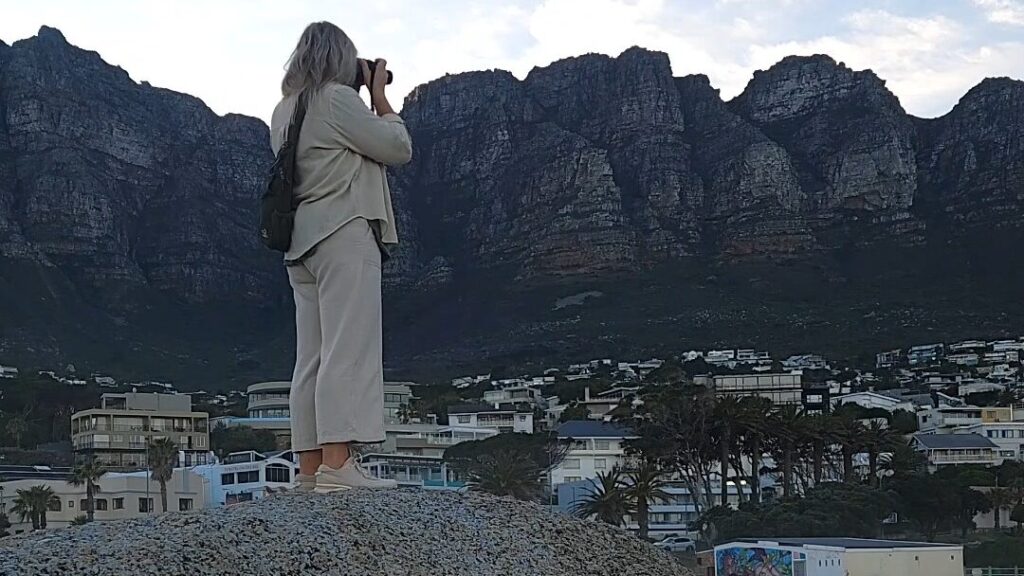
I went kayaking.
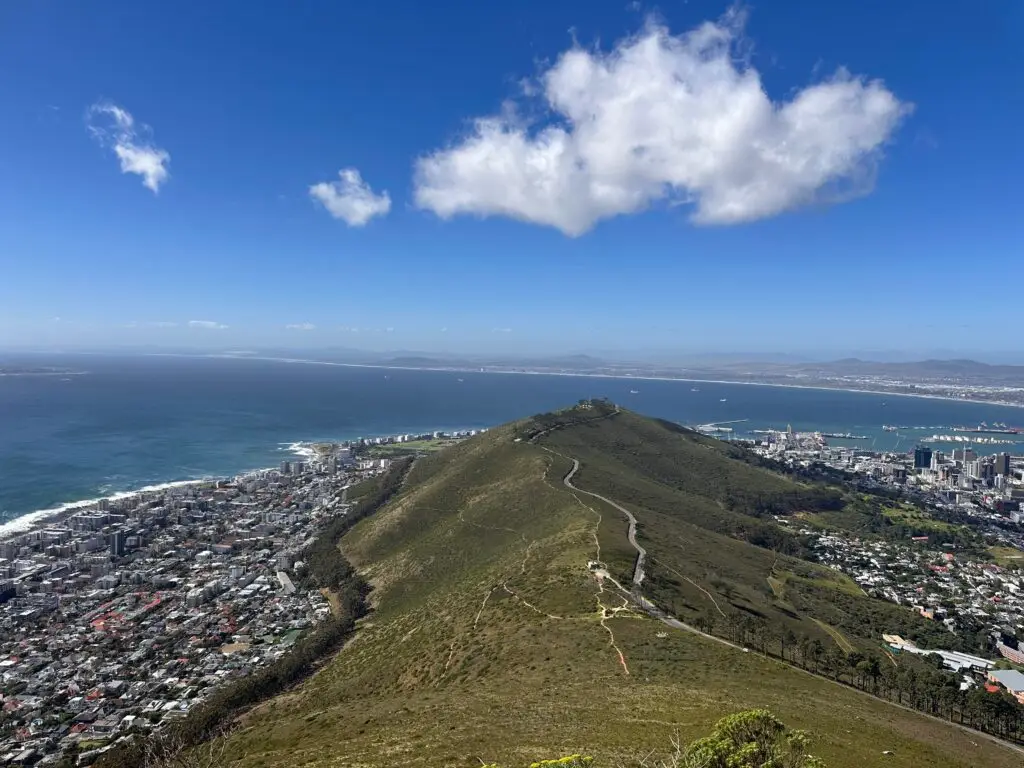
I went up Table Mountain.
I tried to paraglide twice and Cape Town’s wind told me to go fuck myself twice.
Actually, the wind became a recurring character in this trip. It screwed with hiking, kayaking, whale watching and a cruise. Cape Town weather does not care what Viator says you’re doing at 2 p.m.
I loved that Cape Town. But then I went to District Six and walked Woodstock with Diego, and suddenly the geography around me started making considerably more sense.
Go to District Six Before You Decide You Understand Cape Town
District Six wasn’t interesting to me because I needed to dutifully complete the “apartheid history” portion of my vacation. It was important because it changed what I was looking at afterward.
Under apartheid, District Six was declared a white area and tens of thousands of residents were forcibly removed from their homes. The District Six Museum isn’t simply displaying that history behind glass. Much of it is built around memory; former residents, families, maps, photographs and the stories of people whose neighborhood was deliberately dismantled.
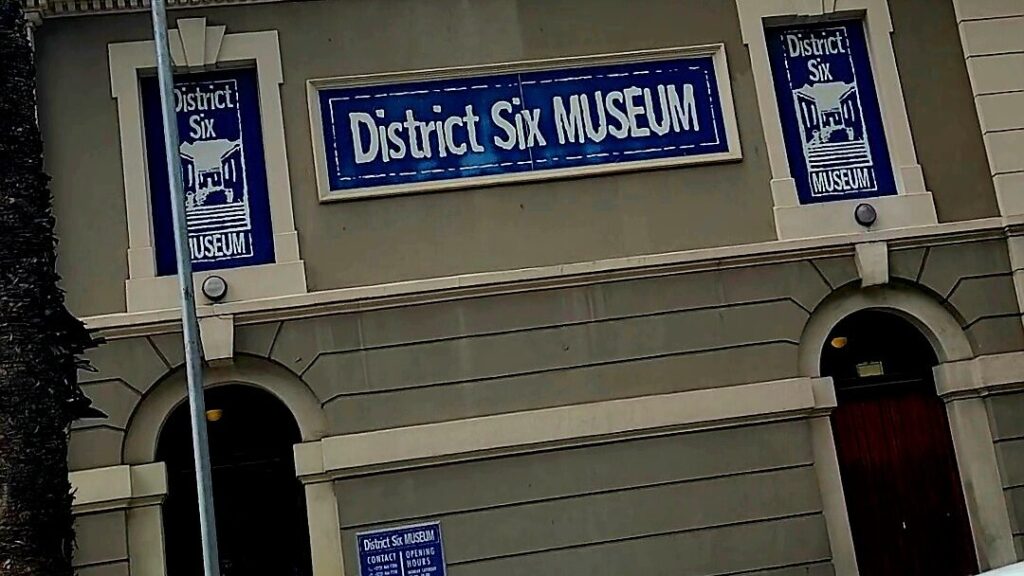
There is something very different about learning history when the people whose lives were disrupted aren’t abstractions in a textbook. Once you understand forced removal, displacement and the deliberate restructuring of communities, Cape Town becomes considerably harder to consume purely as scenery.
That became even clearer when I went to Woodstock.
Woodstock Was One of My Favorite Things I Did in Cape Town
I should probably explain that I did not wander into a street-art tour knowing nothing about street art. I’m a street-art fanatic. I was already familiar with artists and asking Diego questions almost immediately, and at some point he basically acknowledged that he normally has to sell people on the tour while I had shown up ready to interrogate him.
That changed the entire experience.
I ended up being the only person on the tour, and once Diego realized how genuinely interested I was, he started adding things. We went into parts of the neighborhood that weren’t normally part of his route. He knew several of the artists, so we weren’t just talking about what was painted on a wall. We were talking about who painted it, what was happening in the neighborhood, politics, displacement and why certain pieces were there at all. There were murals supporting Palestine. I learned that Woodstock was once along the beachfront before land reclamation physically changed Cape Town’s shoreline.
That’s the shit I want to know. I can look at a mural by myself. I want to know why it’s there.
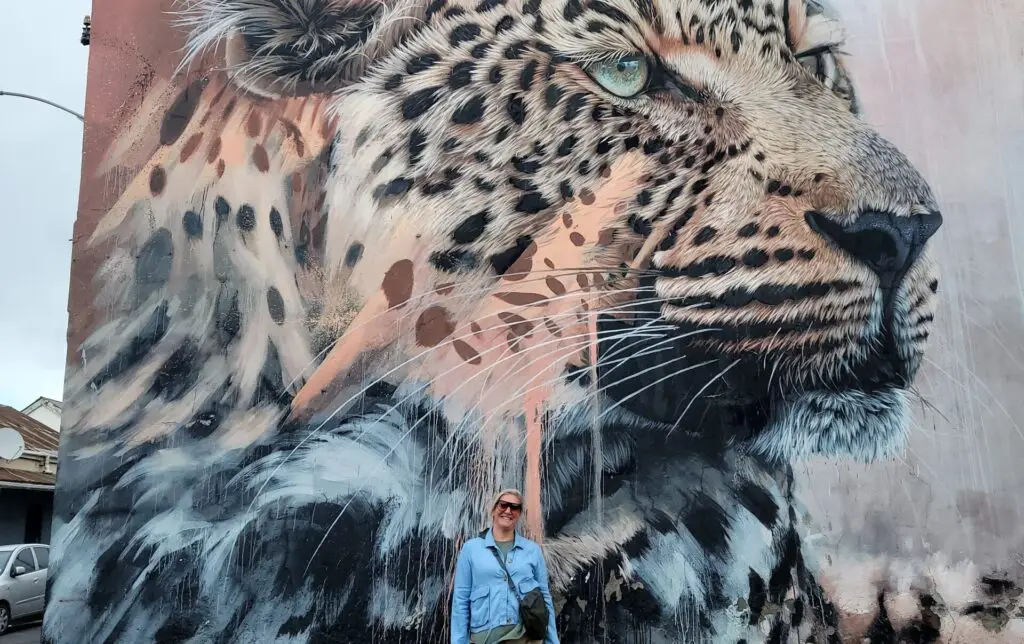
By the end, it felt considerably less like I was following a tour guide and more like I was walking around with someone I happened to really like who knew a ridiculous amount about his neighborhood. We stayed in touch. Diego has since started his own company, and he’s still one of those people I keep in my travel Rolodex. I don’t throw those people around casually, either. But if someone were planning South Africa with me and heading to Cape Town, there is a very good chance I’d send them to him.
I also wouldn’t have wandered around Woodstock by myself. Partly because there were areas where I wouldn’t have felt completely comfortable alone, but mostly because without Diego I would have walked past half the things that made the neighborhood interesting and had absolutely no fucking idea what I was looking at.
That is exactly why I sometimes pay for a guide. Not because I’m incapable of walking, but because context is the difference between seeing something and actually understanding what the hell you’re seeing.
Cape Town Kept Doing This to Me
I could go from Woodstock to Bo-Kaap, then Company’s Garden, then contemporary African art at Zeitz MOCAA, then back to Camps Bay where the Atlantic is crashing into the coast and everything looks suspiciously like an advertisement for very expensive face cream.
And somewhere in all of this, I was eating exceptionally well.
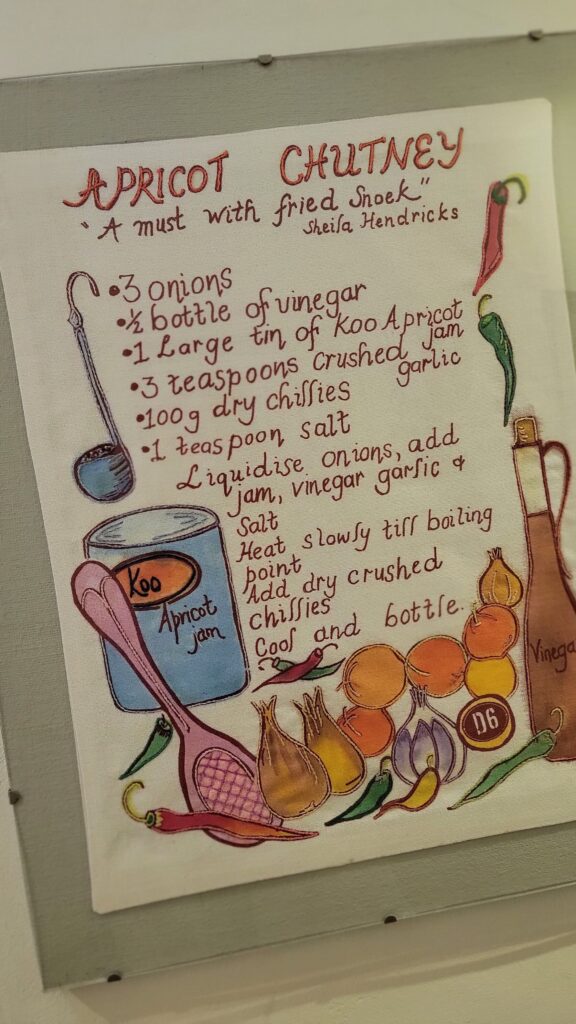
I don’t talk about South Africa enough as a food destination, and that’s ridiculous considering South Africa, Zambia and Zimbabwe collectively gave me some of the best eating I’ve had anywhere outside Vietnam. Bobotie alone has become one of my favorite fucking foods. I loved it enough that it followed me home in the form of spices because apparently eating something once and enjoying it isn’t sufficient for me. I need to start recreating it in my kitchen.
And food is another place where Cape Town’s history shows up whether you realize it or not. The Cape Malay cooking traditions associated with dishes like bobotie are part of a much larger story involving slavery, colonialism, migration and the communities that developed at the Cape. I don’t need every dinner to become a history lesson, but I do want to understand why the food I’m eating exists where it does.
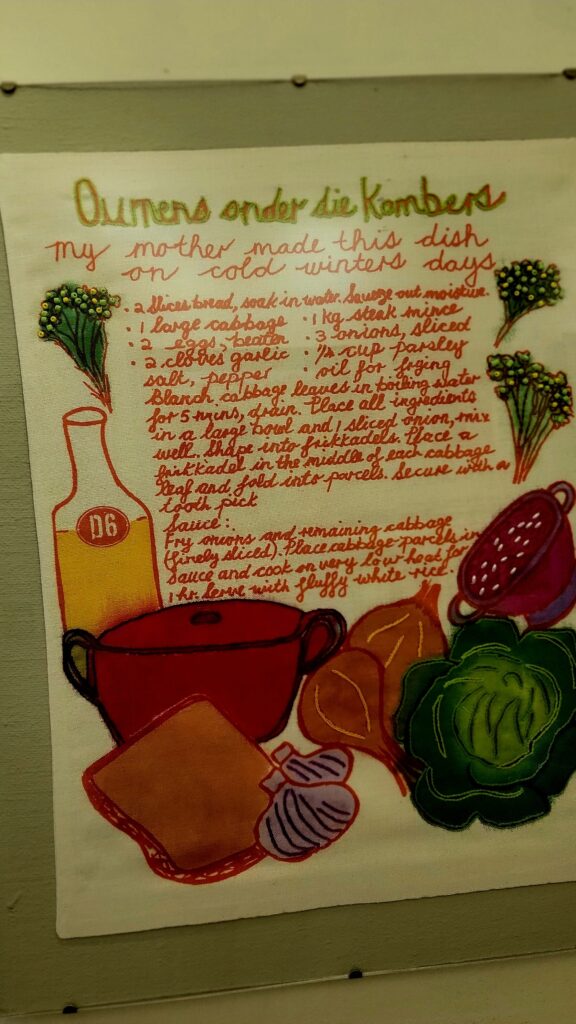
That’s really Cape Town for me. I love beautiful hotels. I like wine. I like sitting somewhere ridiculous with a view and ordering another glass because apparently fiscal responsibility does not cross international borders with me. I also want the museum, the street art, the food and the person who tells me the story I wouldn’t have known to ask about.
I don’t think those versions of the city cancel one another out. I think you need the contradiction.
That’s also why I regret missing Robben Island.
I did a lot in Cape Town. I wasn’t sitting at Camps Bay drinking cocktails for a week pretending apartheid was something that happened in another country, and I still came home thinking I didn’t get enough of the history. If I went back tomorrow, the official Robben Island Museum would be one of the first things I booked.
Because if you’re going all the way to Cape Town, I don’t think you should come home understanding Table Mountain better than you understand the country standing underneath it.
The Cape Winelands Are Not a Cute Little Add-On to Cape Town
Now let’s talk about wine, because I contain multitudes. I can spend the morning contemplating forced displacement and the afternoon becoming emotionally attached to a Chenin Blanc. Both things can be true.
I did two very different versions of wine country: Constantia, which is easy to reach from Cape Town, and then the larger Cape Winelands around Stellenbosch. Do both if you have time, and don’t treat the Winelands like you need to speed-run four estates so you can announce that you “did Stellenbosch.”
At Kanonkop, I got to see the actual production side—the cellars, bottling and labeling, and bottles from different vintages going back decades. There was even an undusted 2020 bottle sitting there like a tiny alcoholic monument to the year everyone would prefer to forget. The Paul Sauer was my favorite wine there.
Then there was Stark-Condé, which is stupidly beautiful. The tasting room sits over the water with mountains behind it and willow trees around it. It is exactly the kind of place that makes you briefly consider abandoning your current life and becoming a woman who owns linen pants.
We ate at Postcard Café, where I had a fantastic steak, and I found Elsje Designs tucked upstairs—one of those little discoveries I love because I wasn’t expecting it. I came home with a mouse pad inspired by the region because apparently this is what happens when I travel: everyone else buys magnets and I return with aggressively specific office supplies.
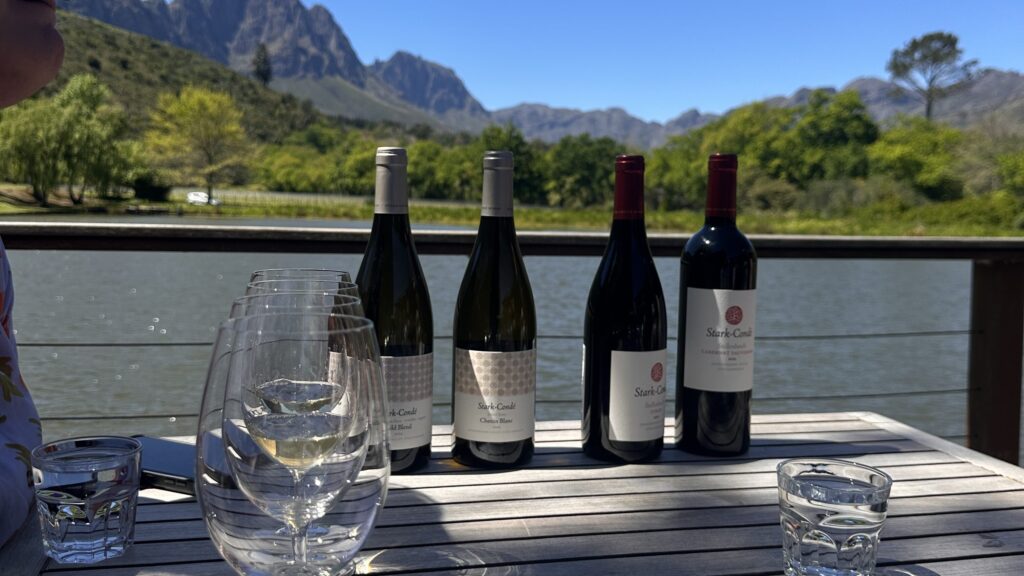
My complaint? We were rushed. I had maybe an hour there, and I wanted more time to look around, ask questions and actually enjoy the place.
This is one of my biggest problems with winery tours that try to prove their value by taking you to as many estates as humanly possible. I don’t need six wineries. I need enough time at the good ones.
And Then There Was Rainbow’s End
My favorite winery of the entire trip, and possibly one of my favorite wineries I’ve been to anywhere.
Rainbow’s End is family-run, up in the mountains, with protea and fynbos growing around the property. You drive in past flowers and arrive somewhere that doesn’t feel like it was designed by a hospitality conglomerate after an extensive focus group on “authenticity.”
And then there was the Chenin Blanc.
I love Chenin Blanc anyway, and this one was fucking fantastic. Crisp, fresh, exactly the kind of Chenin I like. I bought one bottle, which was stupid. I should have bought more.
I have thought about this wine enough since returning home that I have searched for things that taste remotely like it, which is how you know a souvenir has become a problem.
That’s why Rainbow’s End stays in my memory more than some estates that were objectively grander. Travel doesn’t always work according to the official hierarchy of what’s “best.” Sometimes the place you love is simply the one where the wine tastes right, the mountains are ridiculous, flowers are growing along the road and you don’t feel like somebody is waiting for you to vacate the tasting room for the next reservation.
You Don’t Have to Spend the Entire Winelands Trip Drinking
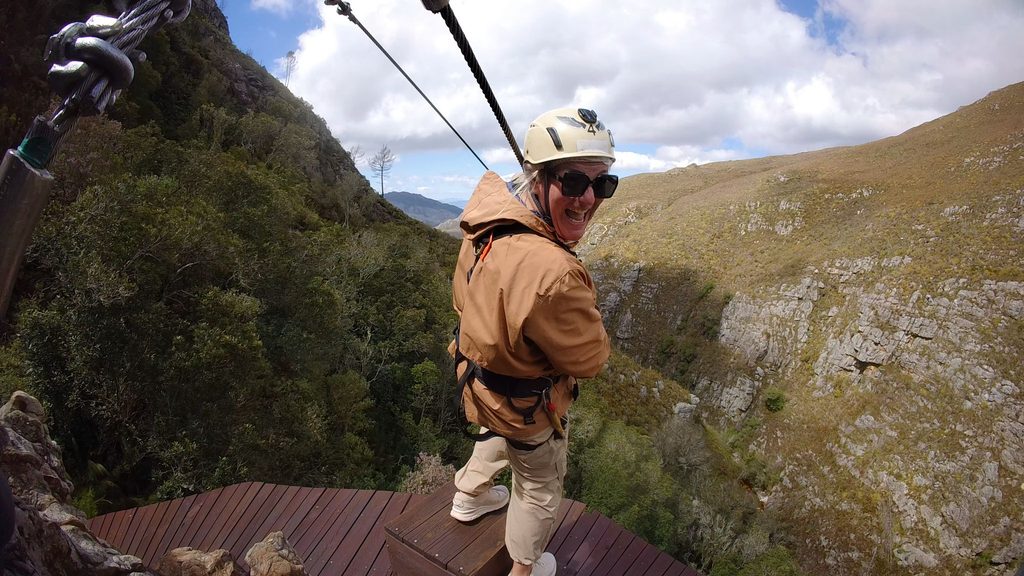
I went back out for a canopy tour in the Hottentots-Holland mountain area, which required a 4×4 ride into the mountains before we started ziplining across the reserve, over ravines and waterfalls.
It was a completely different way of experiencing wine country, and one of the things I hadn’t understood before going to South Africa was how much the mountains dominate this part of the country. The vineyards are beautiful because of where they are.
Get out into that landscape. Then drink the wine.
You’ve earned it.
Hermanus Was Supposed to Be About Whales
This is where travel plans started getting rewritten by the weather again.
Hermanus is famous for whale watching, and I was there during whale season and around the time of the whale festival. Did I actually attend the whale festival? Of course not. That would have been far too convenient.
Our planned whale watching from Hermanus didn’t happen as expected either. Conditions changed the plan, and eventually the actual whale-watching experience moved farther along the Garden Route to Plettenberg Bay.
This is worth knowing because South Africa kept reminding me that nature does not accept reservations. I could plan the trip within an inch of its life; the ocean remained profoundly uninterested in my itinerary.
Hermanus itself was still worth the stop. The coastline is gorgeous, whales can be seen from shore when they’re around, and it also gave me one of the stupidest pieces of local humor from the entire trip: someone had figured out the obvious juvenile possibilities contained within the word Hermanus.
Her anus.
I’m 48 years old. I still found this funny.
Travel is educational.
Hermanus also gave me my first chance to try abalone, which is heavily associated with this part of the coast. I had never eaten it before, so obviously I was going to try it. This is one of the things I love about traveling: if a place is known for something I can’t readily get at home, I’m eating it. I don’t need to know whether I’m going to like it first. That’s rather the fucking point.
Betty’s Bay: Come for Penguins, Get Baboons
Then we hit Betty’s Bay and Stony Point.
African penguins are endangered, so seeing an actual colony isn’t just another cute-animal stop. Although let’s not pretend they’re not cute. They’re fucking adorable.
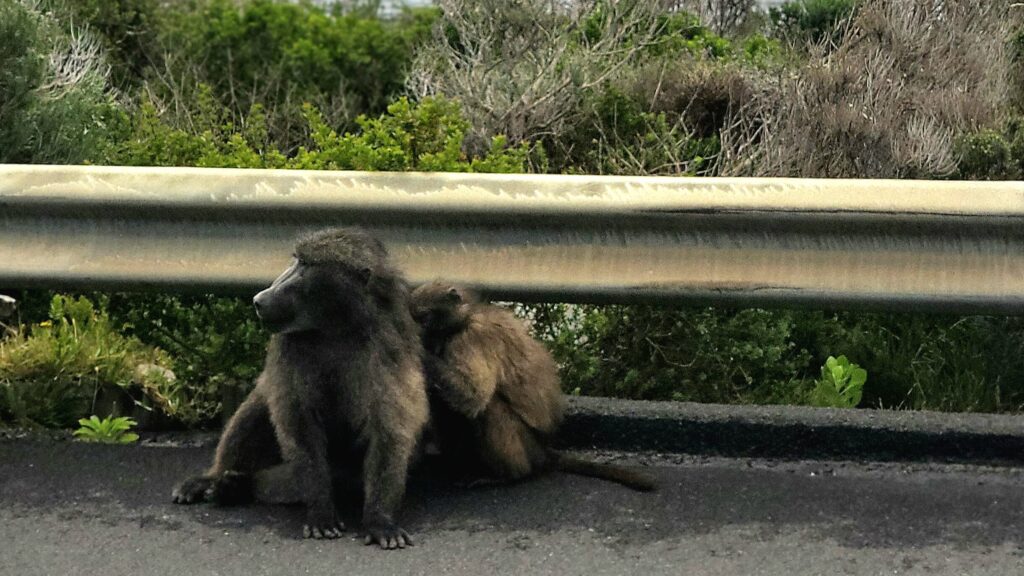
But this was also where South Africa’s wildlife started making it very clear that it wasn’t interested in remaining neatly inside designated tourist attractions. We encountered baboons along the road coming into the area, and that became another recurring theme of the trip: the animals aren’t props waiting for you at the location marked “wildlife experience.” They’re just there.
Baboons come into town. Penguins have predators. Seals, sharks, orcas, whales and penguins all exist inside the same ecosystem, and what happens to one population affects another.
That became much more obvious farther along the coast.
The Garden Route Is Actually Worth the Hype
I hate when scenic drives are described like they’re going to rearrange your molecular structure.
The Garden Route is, however, fucking beautiful, and more importantly, it keeps changing. Forest gives way to coastline, then mountains, lakes and rivers, and suddenly you’re standing somewhere that looks nothing like the place you were two hours earlier.
We stayed around Wilderness at Fairy Knowe, and this is where the trip became considerably more active. There was canoeing, hiking and a waterfall that required considerably more physical effort to reach than the innocent little word waterfall had led me to believe.
This is a recurring travel scam. Anything described as “a short walk to a waterfall” should immediately be interrogated like a hostile witness.
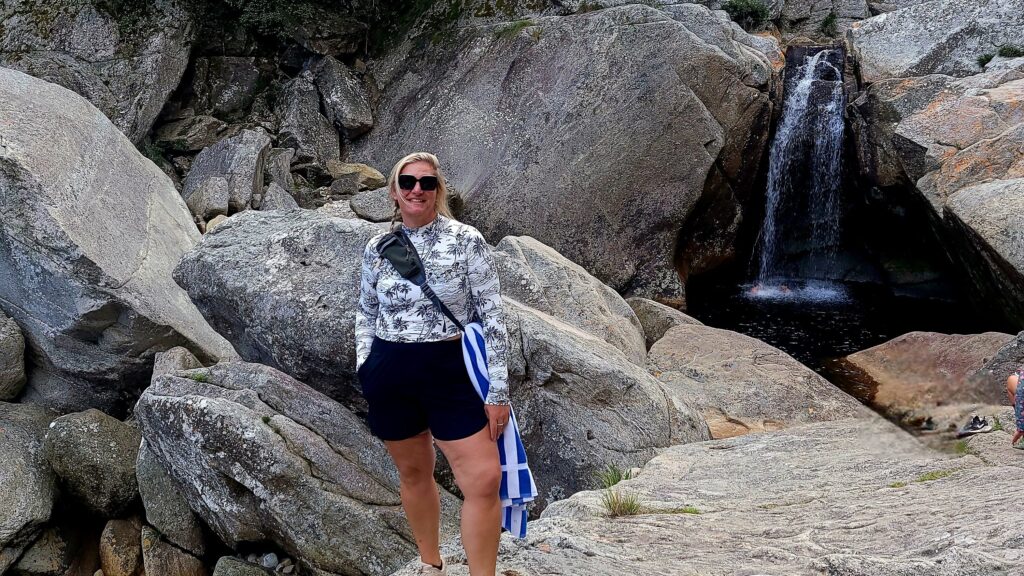
But this is exactly why I wouldn’t do the Garden Route as a drive where you simply keep pulling over for photographs. Get out of the fucking car. Kayak. Hike. Walk through the forest. Let your shoes get dirty. Otherwise you’ve traveled hundreds of miles through one of South Africa’s most interesting landscapes and experienced most of it through laminated glass.
For current park information, trail notices and entry details, use SANParks’ official Garden Route National Park information. Wilderness and Tsitsikamma are both part of the national park, so this is one external link actually worth bookmarking rather than trusting whatever some travel blogger wrote four years ago.
Plettenberg Bay Finally Gave Me My Whales
Remember those whales I was supposed to see earlier? Here they were, and this ended up being better than I could have planned.
The whale-watching boat launched directly from the beach. Not from a nice calm little marina. The beach.
We got on, they launched us into the ocean, and eventually that boat came flying directly back onto the sand. A few women who were already feeling seasick had moved toward the back because they thought it would be better.
It was not better.
They got fucking soaked.
Once we were out there, though, we found two mothers with calves and stayed with them for around an hour. One of the babies kept getting curious and coming closer to us, and every time it got a little too interested, Mom basically redirected it.
That was what fascinated me. Suddenly I wasn’t looking at “a whale.” I was watching behavior—a baby testing boundaries and a mother managing it. The same basic family dynamic happening in an animal weighing several tons.
There was also an enormous seal colony. Swimming with the seals wasn’t happening because of a rabies outbreak, which was probably for the best considering how complicated that ecosystem already is.
This entire stretch of coast made me much more interested in the relationship between the animals than simply checking species off a list. Whales, seals, sharks, orcas and penguins are all eating, avoiding being eaten, raising babies or screwing up somebody else’s food supply.
Nature is considerably messier than the brochure.

Plettenberg Bay wasn’t just whales, either. We also had a private evening catamaran trip with a braai onboard, and it was phenomenal. The original plan was to take the catamaran out into the open ocean, but once again South Africa’s weather had other ideas. The water was too rough, so we stayed inside the bay instead.
And honestly? It didn’t ruin a fucking thing.
We were still out on the water at night, eating a proper South African braai from the catamaran, drinking and watching the coastline around us. It was one of those times when the thing you booked isn’t technically the thing you end up doing, but you stop caring because what you’re doing instead is already pretty damn good.
Tsitsikamma Made Me Wish I Had More Time
By Tsitsikamma, I had reached the point where I wanted the itinerary to slow the hell down.
We did the walk out toward the suspension bridges at Storms River Mouth. The hike itself wasn’t particularly difficult, but there were a lot of stairs. Apparently South Africa had decided my glutes had not yet contributed enough to the trip.
The scenery was spectacular: indigenous forest running almost directly into rugged coastline, the river mouth below and suspension bridges stretching across the water.
And this is one of the places where I would change my trip.
I wanted more time. I would have liked to kayak there and explore more of the park instead of reaching the headline attraction, admiring it and moving on.

That’s something I notice more and more when I travel. The places I regret aren’t usually the ones I skipped entirely. They’re the places where I got just enough of something to realize I should have stayed longer.
Tsitsikamma was one of those.
Then Go on Safari—and Give It Enough Time
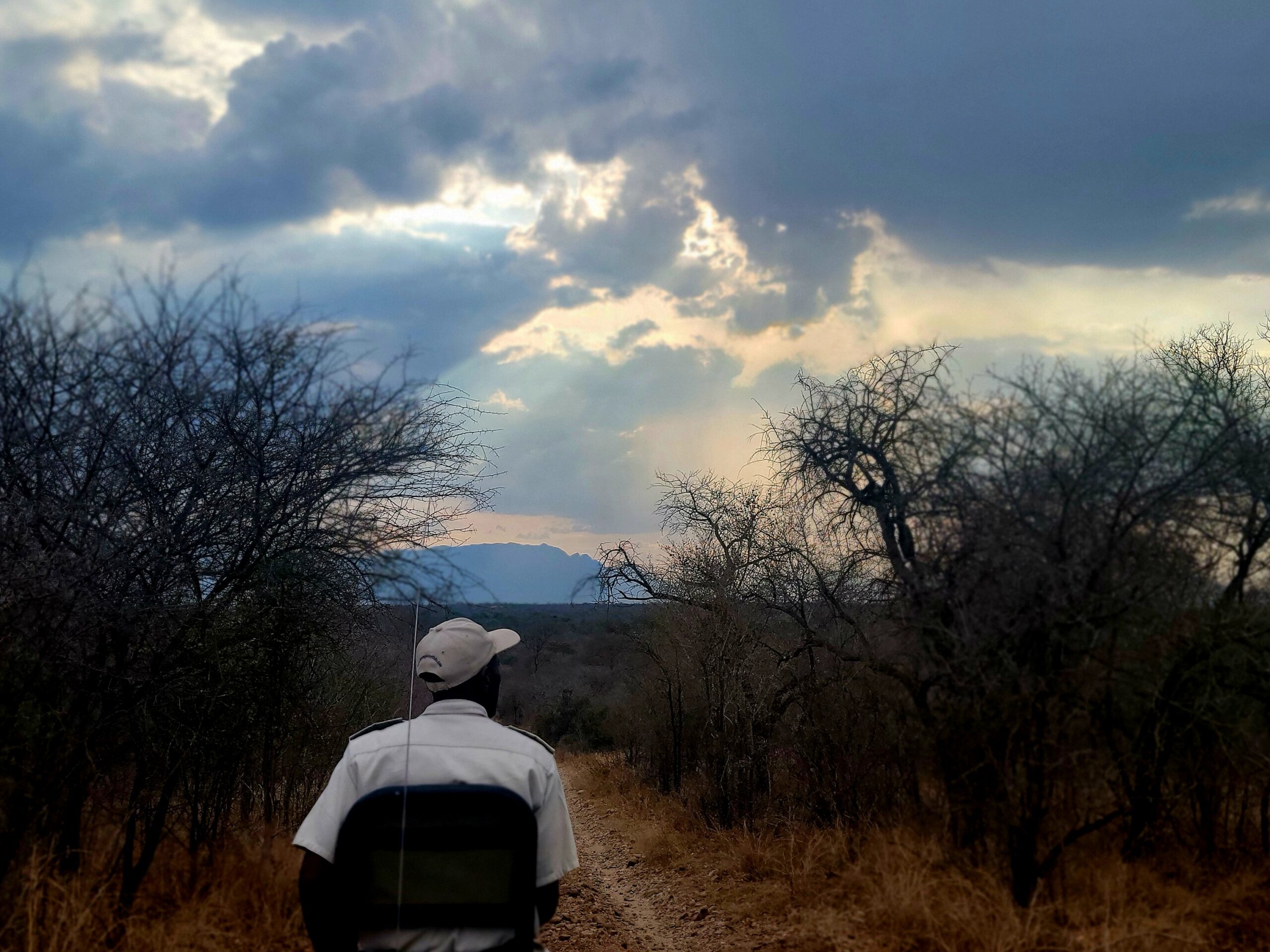
After Cape Town, wine country, whales, coastline and forest, we flew north and went to Karongwe Private Game Reserve in South Africa’s Greater Kruger region.

Safari operates on a completely different schedule. Our game drives were roughly three hours, twice a day—early morning and late afternoon into evening—which means you are getting up around 5 a.m. on vacation, voluntarily, and somehow you don’t even resent it because there might be a lion involved.
There were morning coffee stops and evening sundowners. After dark, we were escorted back to our rooms because this was not Disney’s Animal Kingdom and the animals did not clock out when the tourists went to bed.
And this is where safari becomes much more interesting than a checklist of the Big Five.
We saw an extraordinary amount of wildlife, including the Big Five, hyenas and African wild dogs, but some of the things I remember most weren’t the headline sightings at all. They were the weird little things our guides taught us along the way; like why fresh hyena poop is almost shockingly white, how elephant dung has been used medicinally, and how much information is sitting in the bush that I would have walked straight past without knowing what the hell I was looking at.
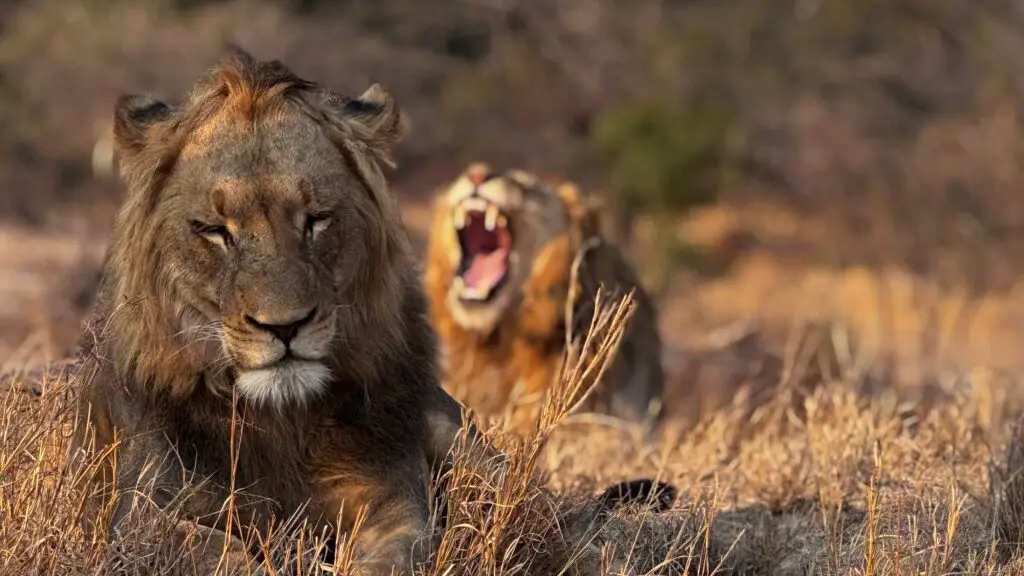
The males? Giant fucking house cats.
They were so comfortable around the safari vehicles that one of them essentially used the area directly in front of our truck as his personal litter box.
Majestic. Regal. King of the jungle, taking a shit in front of my vehicle.
This is why I love animals.
I could go considerably further down this rabbit hole…and I will. Safari deserves its own blog because apparently I returned from Africa with strong opinions about lions, hyenas and animal poo. Which apparently, also contains multitudes. For now, just know this: seeing the Big Five was incredible, but learning what I was actually looking at was better.
Safari Is Better When You Stop Demanding a Performance
You cannot control what you’re going to see, and that’s the entire point. Some drives are ridiculous. Some are quieter. Sometimes the animal you’ve been hoping to see doesn’t appear. Sometimes something you hadn’t been particularly excited about ends up being fascinating because you actually get to watch what it’s doing.
Give safari enough time for that to happen.
If you only allow yourself one or two drives, every hour starts carrying this weird pressure about whether you’ve seen the lions, the elephants or “everything.”
You haven’t.
You’re never going to.
That’s what makes it good.
So What Are the Best Places to Visit in South Africa on a First Trip?
Based on the South Africa I’ve actually traveled, this is the route I’d recommend for a first trip:
Cape Town → Cape Winelands → Hermanus and Betty’s Bay → Garden Route → safari.
Not because those are the only places worth visiting. They’re not. But that route gives you a remarkable amount of contrast without requiring you to treat an enormous country like you’re trying to complete it.
Give Cape Town real time and do both the beautiful shit and the uncomfortable history. Go into the Winelands, but don’t turn wine tasting into competitive drinking with transportation. Take the Garden Route slowly enough to get out of the car. And finish with enough safari time that the animals are allowed to be animals instead of items on your vacation checklist.
You do not need to add Johannesburg, Durban, the Drakensberg and the Karoo simply because somebody published an article called “17 Places You Absolutely Cannot Miss in South Africa.”
You can miss them.
I did.
That’s why return trips exist.
And if you’re wondering why this route looks a little different from the South Africa people think they know from tourism marketing, that’s exactly what I get into in What Everyone Gets Wrong About South Africa.
The Biggest Thing I’d Change About My South Africa Trip
I’d add more history. Not another winery or another scenic overlook. History.
And I didn’t realize that as clearly until after I came home.
I spent time in District Six. I walked Woodstock with someone who helped me understand what I was seeing. I went to museums, talked to people and paid attention. I wasn’t completely oblivious to the history of the country I was traveling through.
But I still think the trip needed more. Most notably, I missed Robben Island, and that bothers me more now than it did while I was there.
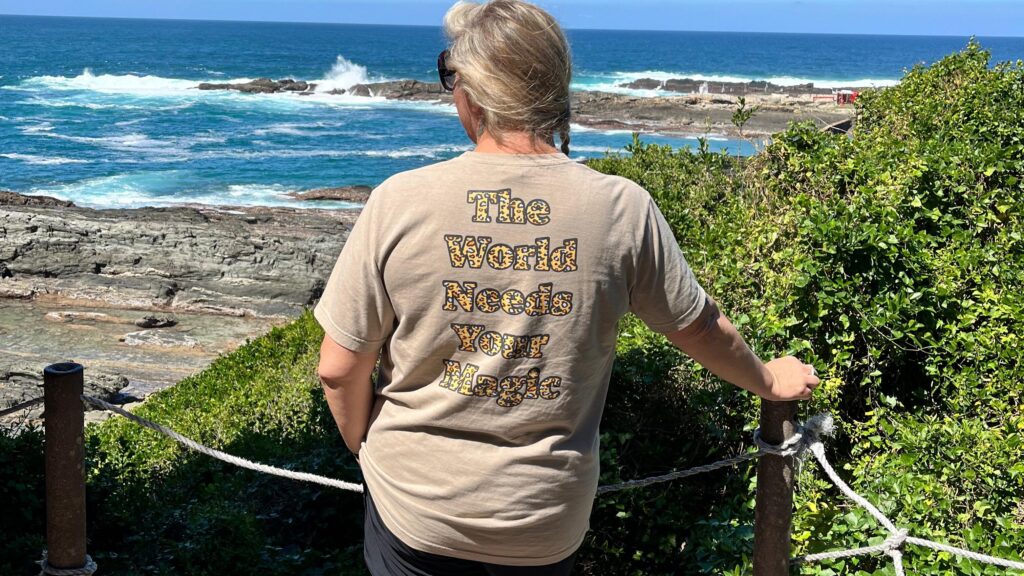
Because South Africa makes it incredibly easy to build a spectacular itinerary. Cape Town is beautiful, the wine is excellent, the coastline is ridiculous, the food is some of the best I’ve eaten anywhere and the wildlife is extraordinary. You could spend two weeks moving from one objectively fantastic experience to another, come home with 4,000 photographs and still not understand enough about where you just were.
That’s the trap.
Not because you need to turn vacation into a graduate seminar. Fuck that. I’m still drinking the wine, getting in the safari vehicle, eating the bobotie, going to the beautiful hotel and ziplining across the mountain because apparently I enjoy signing waivers in foreign countries.
I just don’t want the history and culture of a place relegated to the two-hour educational activity between the things we consider fun.
I went to South Africa thinking about Cape Town, wine, the Garden Route and safari. I came home thinking much more about how all of those things fit together, what I had learned while I was there and how much of the story I still hadn’t heard.
That, more than anything, is why I’d go back. Not because I failed to “complete” South Africa, but because now I know better than to try.