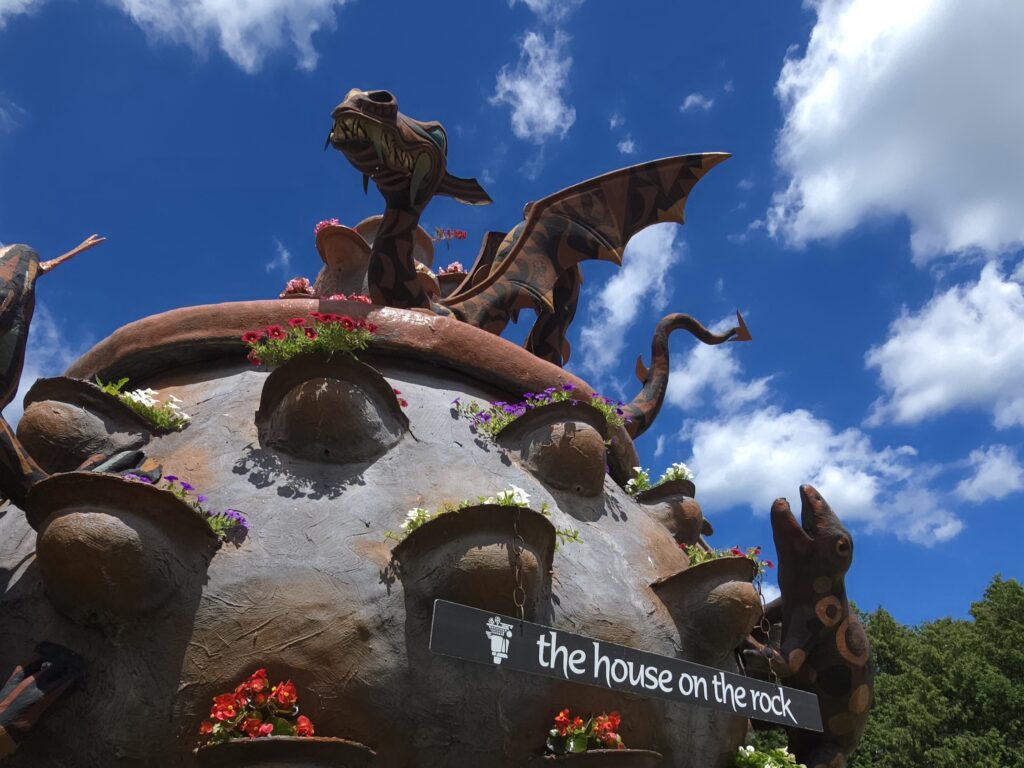
The House on the Rock in Wisconsin is essentially what would happen if ADHD developed a personality, inherited an enormous amount of money and was never at any point in its life told no.
Not once.
Every ridiculous idea was approved. Every obsession became a room. Every room became an entire building. And apparently nobody ever took Alex Jordan aside and said, “Darling, perhaps we don’t need another carousel full of dolls.”
Which is precisely why you have to go.
Located near Spring Green, approximately an hour west of Madison, the House on the Rock is one of the strangest tourist attractions in Wisconsin and possibly anywhere else on the planet. It includes an architectural oddity built directly into the rock, the gravity-questioning Infinity Room, mechanical orchestras, thousands of dolls, a room-sized carousel and a 200-foot sea creature attacking a whale.
This is not a tasteful afternoon at a historic house.
This is an endurance event for the eyes.
Why I Wanted to Visit the House on the Rock
I first became interested in the House on the Rock because of American Gods.
I watched the television show, never read the book and now refuse to read it because I discovered that my favorite characters do not have the same story arcs. They were quite literally the reason I watched the show, so I will be protecting my peace and remaining blissfully illiterate on the matter.
However, the House on the Rock appears in both Neil Gaiman’s novel and the television series, and the show actually filmed at the real Wisconsin attraction.
Not “inspired by it.”
Not “loosely based on it.”
They packed up the cast and went to Wisconsin because recreating the place would have been impossible.
Neil Gaiman explained in an interview with Vanity Fair that although the production could construct certain sets, most of the House on the Rock material needed to be filmed at the actual attraction because reproducing it would be impossible.
And having now visited, I completely understand.
No production designer could pitch this place without being escorted from the building.
The House on the Rock Starts Off Suspiciously Normal
The House on the Rock lulls you into a false sense of security.
You arrive through a peaceful Asian-style garden. There is greenery. There is water. There is a little waterfall. Everything feels calm and tasteful.
You think, “Oh, lovely. A quirky architectural tour.”
What follows is neither calm nor particularly interested in taste.
You begin inside the Original House, which is dark, low-ceilinged and built around the rock itself. The rooms have a distinctly 1970s feeling, all narrow passageways, built-in seating, colored glass, shag-adjacent energy and little windows overlooking the trees.
It is odd, certainly, but manageable.
You think you understand the assignment.
Then you reach the Infinity Room.
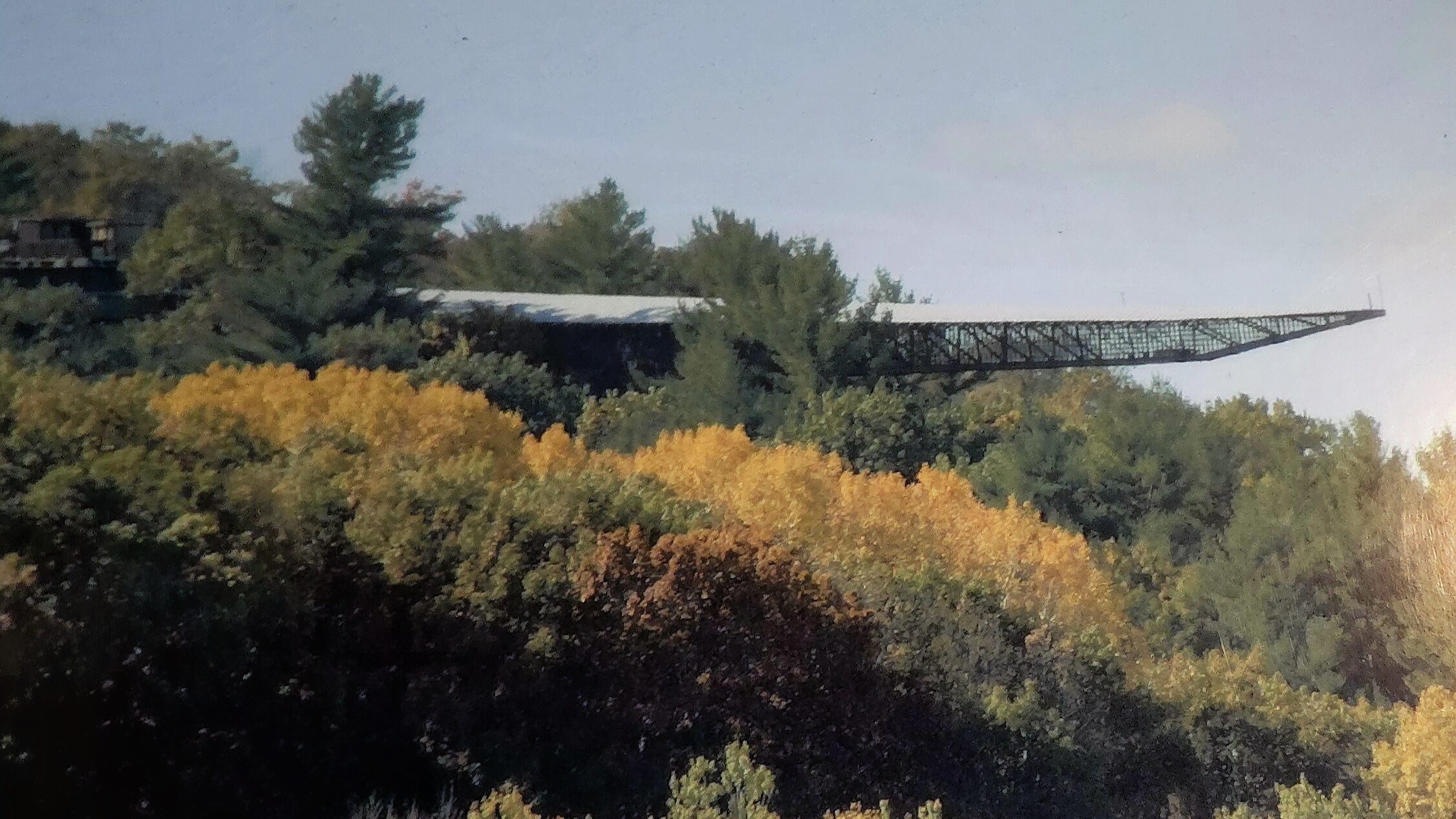
The Infinity Room: An Engineering Feat
The Infinity Room is a long glass corridor extending 218 feet over the valley, with more than 3,000 pieces of glass.
It becomes narrower as you walk toward the end, creating the illusion that it carries on forever. Beneath it is mostly air, trees and the growing realization that you voluntarily paid money to walk into a giant architectural needle hanging over a Wisconsin valley.
From a distance, it looks impossible.
From inside, it feels even less sensible.
The room is cantilevered out from the rock, meaning there are no columns conveniently propping it up directly underneath. Somewhere, obviously, there is engineering involved. I assume calculations were performed. Presumably professionals signed paperwork.
None of this is particularly comforting when you are standing near the end of it. It also moves.
Not dramatically. It is not flapping around in the breeze like a windsock. But you can feel enough movement to remind you that you are not standing on the ground and that turning back would require admitting defeat in front of everyone behind you.
This is still only Section 1.
You have barely begun.
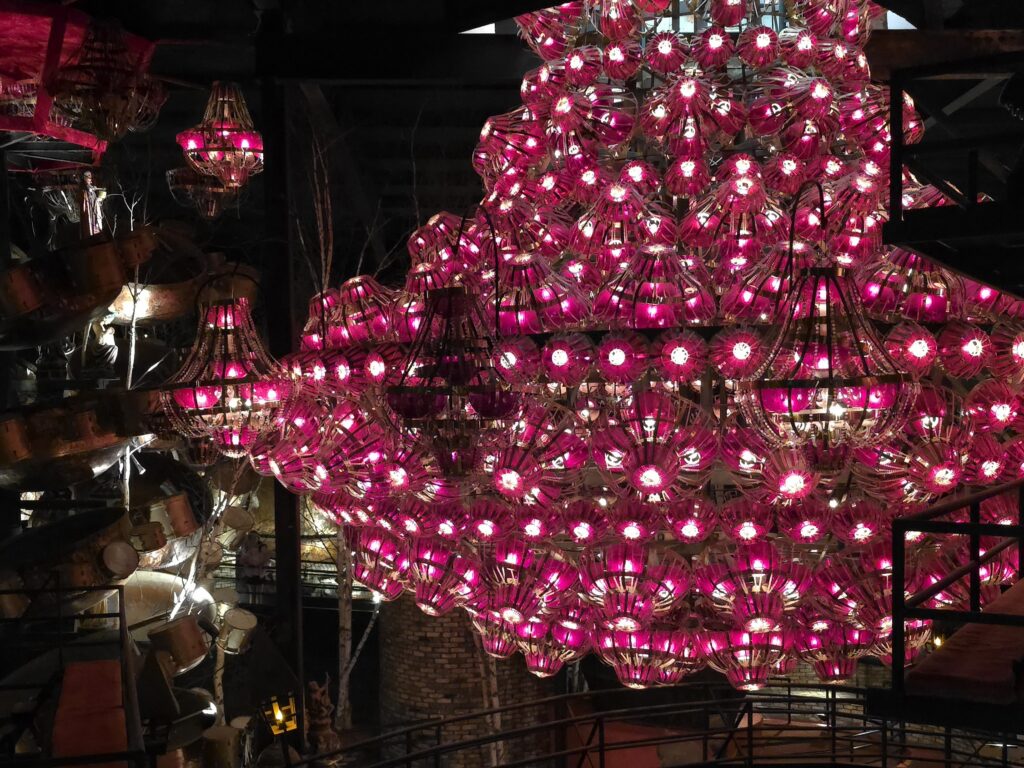
Then the House Takes Its Wig Off
After the Original House, the entire experience stops pretending to be an architectural attraction and reveals itself as the contents of one man’s brain arranged throughout several enormous buildings.
There are collections everywhere.
Dolls. Guns. Cars. Model airplanes. Mechanical bands. Giant organs. Miniature circuses. Nautical displays. Suits of armor. Streets made to resemble another century. Things hanging from the ceiling. Things staring at you from corners. Things that begin moving after you insert a token.
There are entire rooms where your only reasonable response is, “But why?”
The House on the Rock does not answer.
It simply leads you into another room containing 40,000 objects and challenges you to keep up.
The attraction is divided into three sections, and the complete Ultimate Experience includes all three. Section 1 contains the Original House and Infinity Room. Section 2 is where the attraction abandons restraint entirely, introducing the Streets of Yesterday, mechanical music machines, Heritage of the Sea and the carousel. Section 3 continues with enormous organs, circus displays, dollhouses, armor, weapons and, because apparently the first ones were insufficient, more doll carousels. Honestly, once you’re in there is almost no turning back, the only way to go is forward.
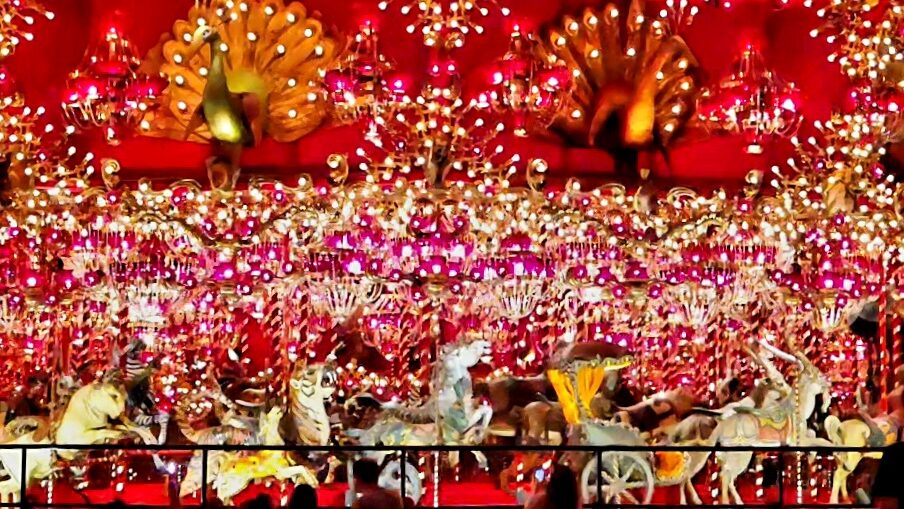
The House on the Rock Carousel Is the Main Event
The carousel was the room I most wanted to see, and it did not disappoint.
It is billed as the world’s largest carousel and contains 269 animals, 20,000 lights and 182 chandeliers.
There are no traditional carousel horses, because apparently horses would have been far too ordinary. Instead, it is covered in fantastical creatures that look as though someone described animals over the telephone while experiencing a medical emergency.
Above it are winged figures suspended from the ceiling. The entire room glows red. Music plays. Everything spins.
And no, you cannot ride it. It is simply there to be enormous.
This is the carousel featured in American Gods, and seeing it in person makes it obvious why the production filmed there. You could spend millions trying to recreate the room and still end up with something that looked disappointingly plausible.
The real thing has the energy of an abandoned Victorian carnival hosting a fashion show in hell (you’ll get the reference when you walk into the next fantastical vision of a room).
It is magnificent.
There Is Also a 200 Foot Sea Monster, Obviously
Just when you think the carousel must be the peak of the madness, you enter Heritage of the Sea.
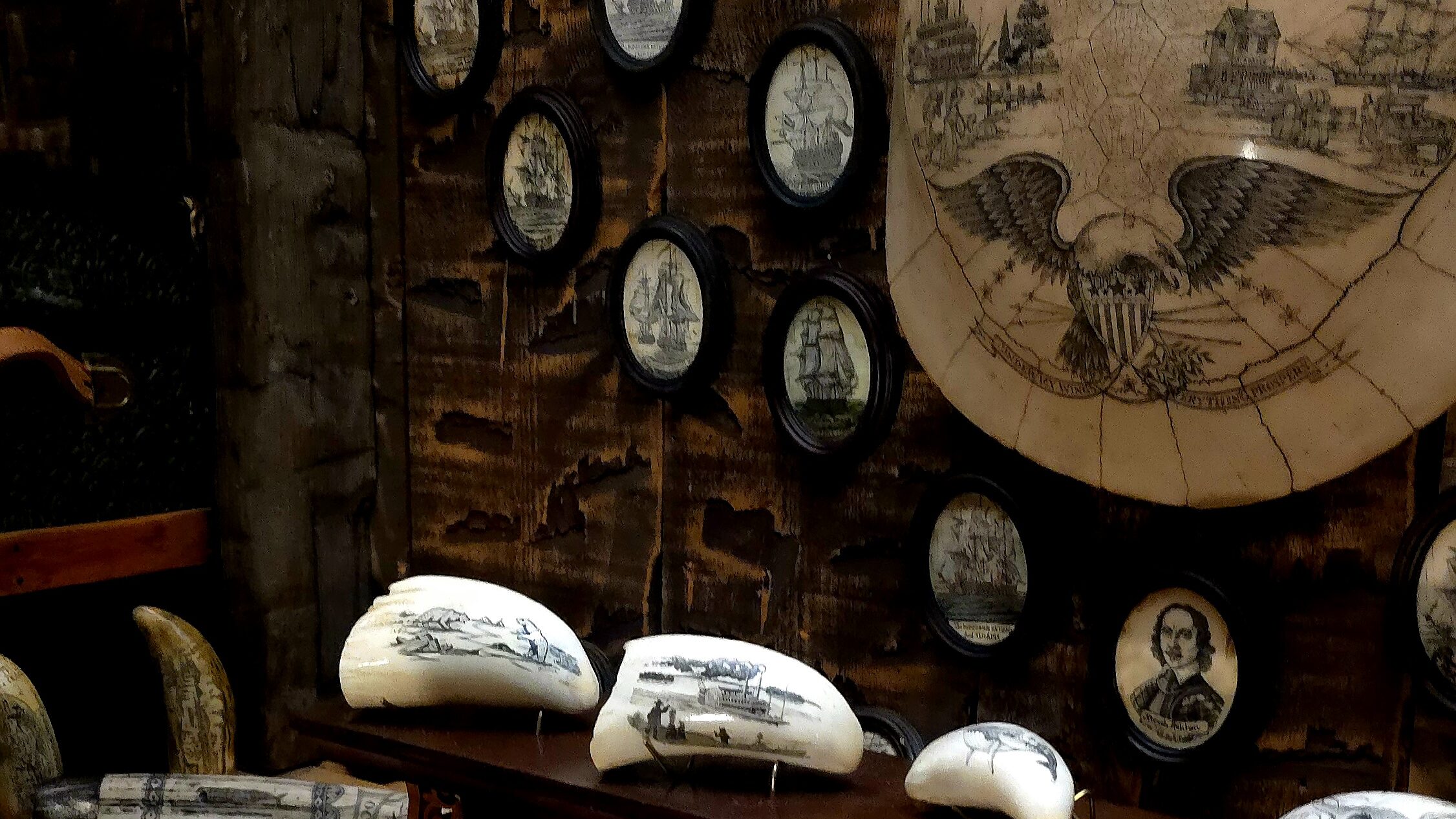
This is a huge, multi-level room filled with nautical exhibits, a Titanic display and more than 200 model ships. Looming over the entire thing is a 200-foot-tall sea creature attacking an enormous whale.
Naturally.
The creature rises several stories through the building. You view it from different levels as you make your way around the room, and it is so large that your brain struggles to understand what it is looking at.
Calling it a sculpture feels insufficient.
It is an event.
It looks like the Kraken, Moby Dick and several maritime nightmares have all become involved in a workplace dispute.
And there is so much going on around it that the gigantic whale-eating monster is somehow not even the only thing demanding your attention.
That is the House on the Rock’s greatest achievement: it can make a multi-story sea creature feel like background décor.
Eventually, Your Brain Simply Resigns
We allowed ourselves three hours.
Three hours sounds generous when someone says you are visiting a house.
This is because the name is a lie.
The House on the Rock is not a house. It is a labyrinth, a museum, a carnival, an antique mall, a fever dream, a mechanical concert and an extremely elaborate cry for help.
By hour two, I had stopped properly looking at things.
There was simply too much. We were trying to move quickly enough to finish while also attempting to process rooms that would have been major attractions on their own anywhere else.
Eventually, your ability to be impressed shuts down as an act of self-preservation.
You pass another mechanical orchestra and think, “Yes, of course.”
You see another carousel full of dolls and barely react.
A winged mannequin descends from the ceiling and you think, “Fine.”
The children had also had enough.
At one point, I heard a child ask, “Mommy, can we just go home?”
And honestly, the child had a point.
Is the House on the Rock Overstimulating?
The House on the Rock is fascinating, but it is also an absolute sensory assault.
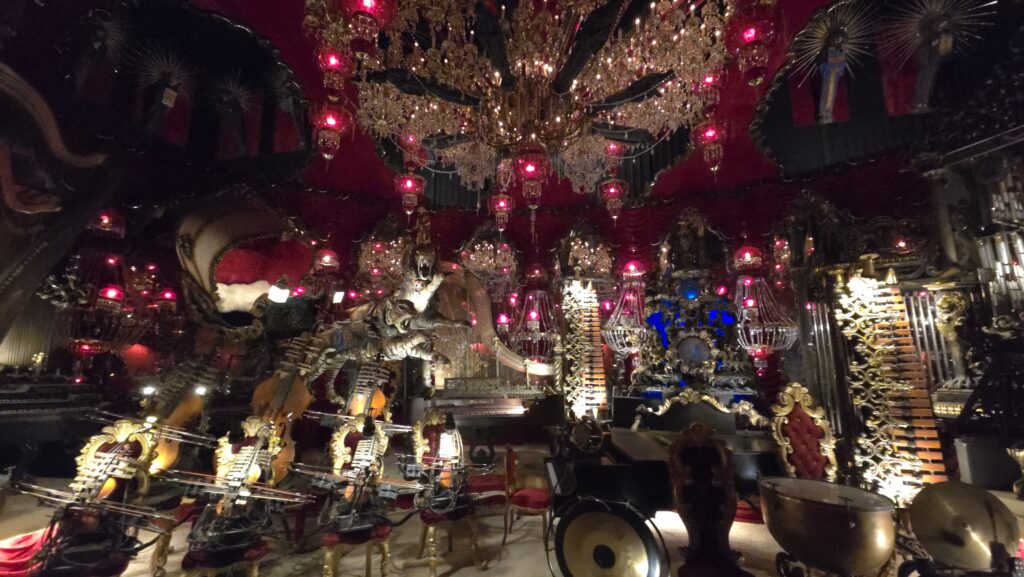
The attraction itself warns that its combination of light, sound and visual stimulation may be difficult for visitors with light or noise sensitivities. It also notes that certain areas may be challenging for people affected by claustrophobia or acrophobia.
There is mechanical music coming from multiple directions. The rooms can be dark and crowded. Things move unexpectedly. There are dolls everywhere, and some of them look as though they know what you did.
It is not peaceful family fun.
It is family survival.
Anyone with significant sensory sensitivities should read the official House on the Rock visitor policies before purchasing tickets.
Yes, There Is Pizza in the Middle
At some point, although time and space had lost all meaning, we reached a café.
There was pizza. There were sandwiches. There was ice cream.
It was fairly nondescript, but finding an entire pizza restaurant in the middle of this visual nervous breakdown felt oddly appropriate.
You sit beneath several thousand inexplicable objects, eat a slice of pizza and try to remember what your life was like before you entered.
Take the break. Even when you are short on time, take the break. Your brain needs carbohydrates.
The attraction does not permit outside food beyond its admission areas, although picnic tables are available near the parking area. Its restaurants and food areas may also close earlier than the attraction itself, so check the current schedule before assuming you can stage a late-afternoon pizza intervention.
And Then It Casually Returns You to the Garden
After the carousel, the dolls, the orchestras, the enormous organs, the weapons and the sea monster eating a whale, the House on the Rock eventually sends you back outside.
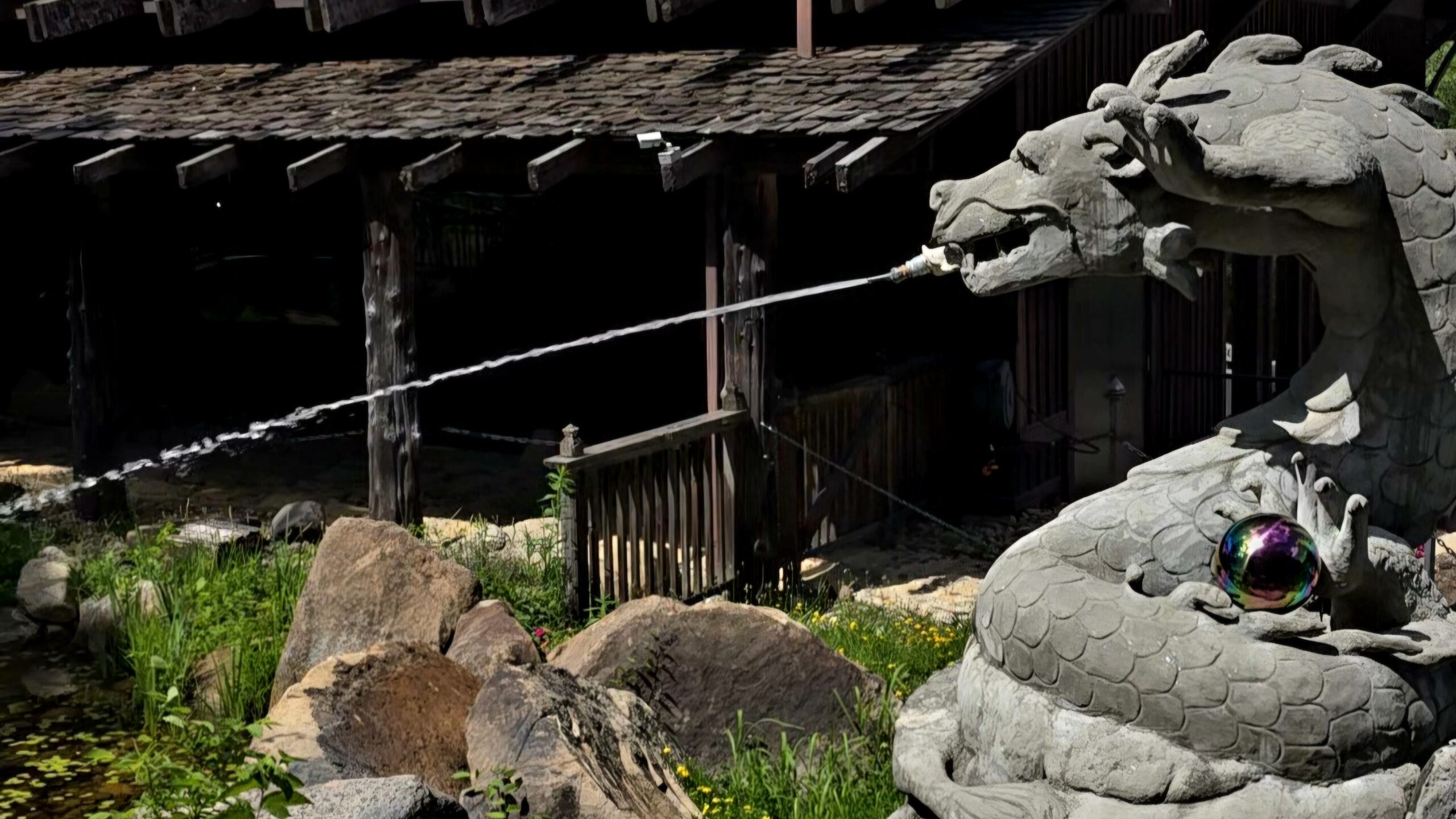
And there is another quiet Japanese-style garden.
Water. Trees. A 14-foot waterfall, I mean it also comes with a big dragon but it fits the scene. Peace.
As though none of it happened.
As though you did not just spend several hours wandering through the physical manifestation of unchecked obsession.
The garden feels less like a pleasant ending and more like a decompression chamber.
You emerge blinking into the daylight, half expecting someone to wrap you in a blanket and ask whether you know what year it is.
You will also appreciate the trees, the pavement and the quiet ride back to civilization while your mind slowly adjusts to reality and your mind tries to comprehend everything you’re eyes just seen.
What to Know Before Visiting the House on the Rock
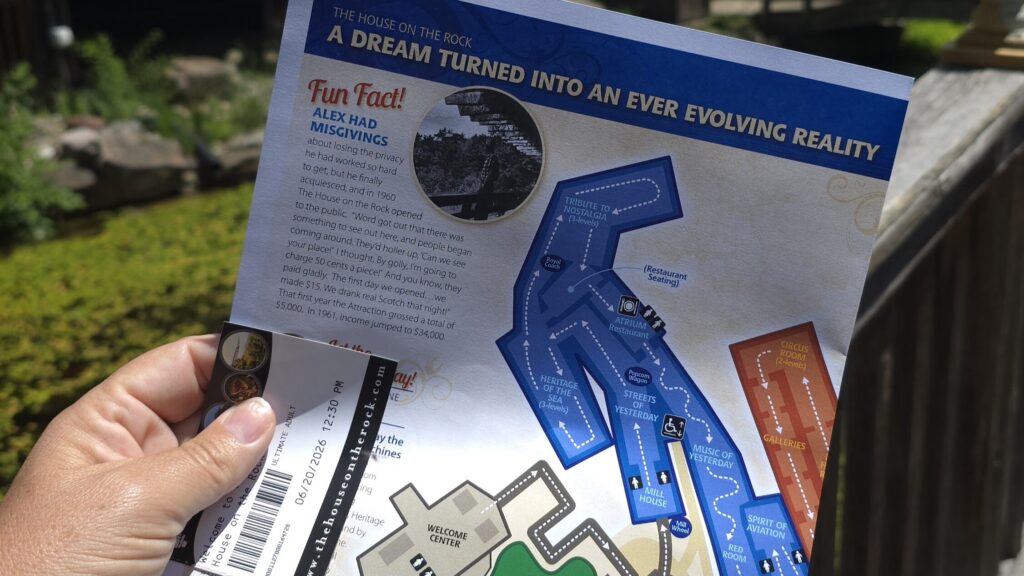
Travel Wisconsin suggests that the entire complex can take half a day to explore. If you enjoy reading signs, activating the mechanical displays, taking photographs or stopping to stare at enormous marine nightmares, four to five hours is far more realistic in my opinion.
Arrive when the attraction opens or as close to opening as possible. Do not arrive at noon (like I did) and expect to see everything without running through like its a marathon sprint at the end. Certain areas begin closing before the overall complex, and later arrivals may receive shortened routes.
Also, the House on the Rock Resort is not the attraction. The resort is a separate hotel and golf property. You want the House on the Rock attraction farther up the road.
Tokens activate many of the mechanical music and entertainment displays. The attraction recommends bringing $1 bills to exchange for tokens in its dispensing machines but just buy the max amount of tokens before you enter, you wont regret it and you will even have a little souvenir before you leave because to be honest, the gift shop was super disappointing. I had so many ideas for that gift shop, seriously, they should hire me!
In October, the House on the Rock hosts a Halloween event called The Dark Side, and during the Christmas season, the entire place becomes even more decorated and unhinged.
Considering the regular season already felt like a haunted antique mall had swallowed a carnival, I can only imagine.
Obviously, I need to go back.
Is the House on the Rock Worth Visiting?
Absolutely.
But you should understand what you are signing up for.
The House on the Rock is not a conventional museum where objects are carefully arranged, clearly interpreted and presented with enough breathing room to contemplate their meaning.
It is accumulation as spectacle.
It is maximalism without adult supervision.
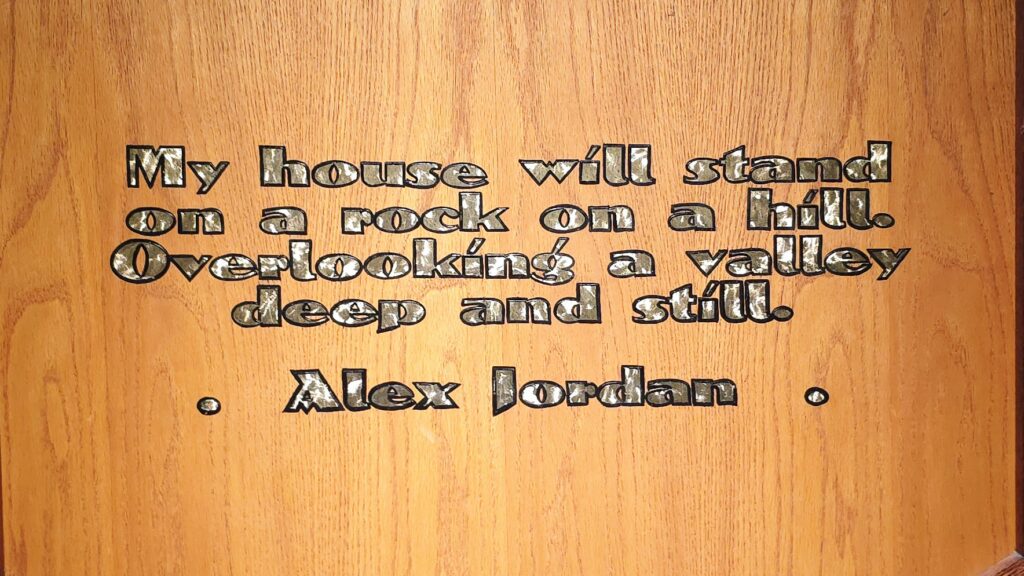
It is one man saying, “I like that,” followed by several decades in which apparently nobody asked where he planned to put it.
Will you love it?
Probably.
Will you occasionally hate it?
Also probably.
Will you ever see anything else quite like it?
Absolutely not.